
EB-5 Refiling Eligibility Under INA 245(k)
As of March 2026, US immigration has recently seen a massive increase in scrutiny across the board. Contrary to our hopes, USCIS has made no exception for those pursuing the EB-5 Investment Visa. I’ve spoken before about increased scrutiny at the I-829 stage, but USCIS’s higher standards and inconsistent adjudication by no means end there. As such, there is an increase in EB-5 denials and filing attorneys, especially those who aren’t EB-5 specialists, are not always prepared with a solution.
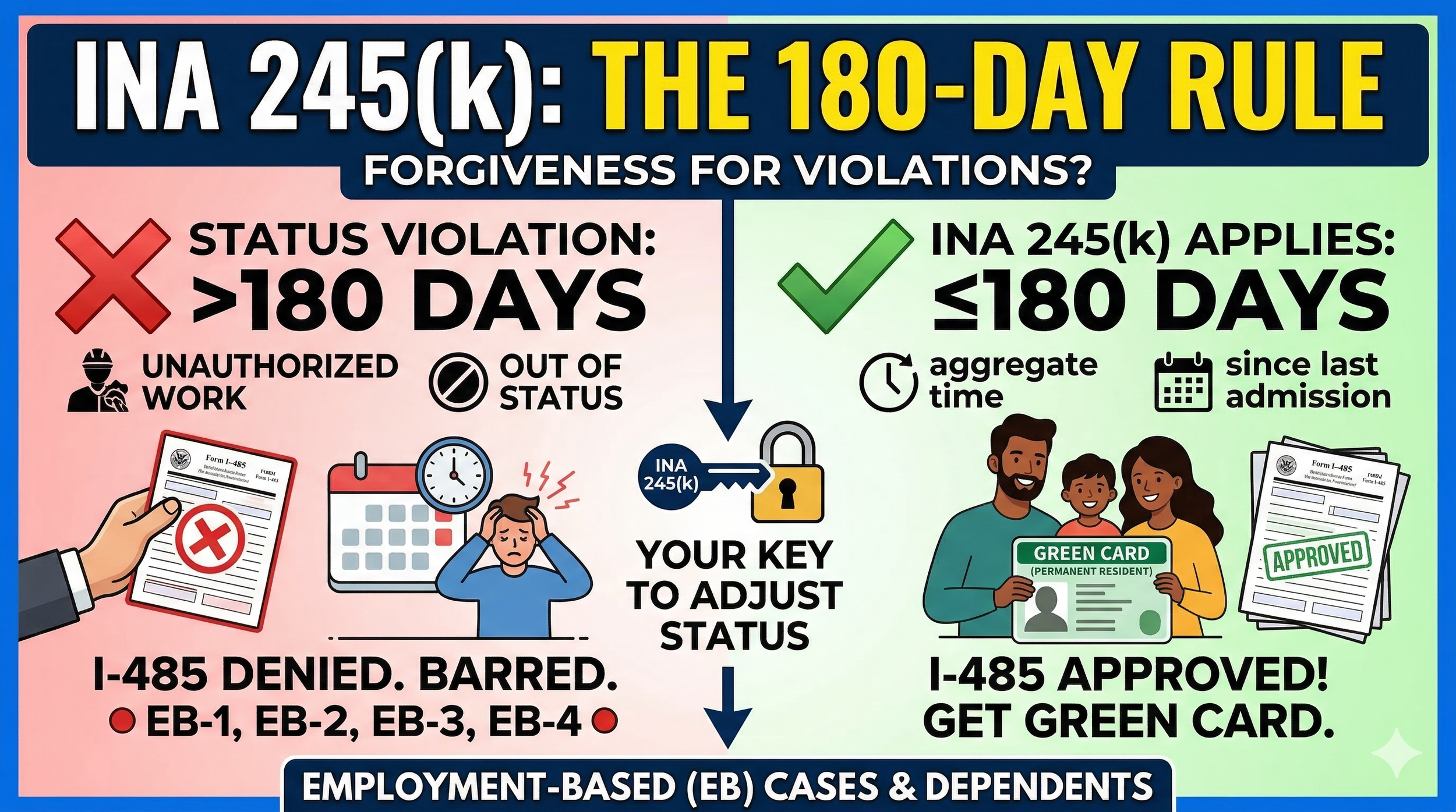
One way to deal with a denial from USCIS is to simply accept it and file a new petition to start the entire EB-5 process over. This is not ideal and for many this could mean potentially needing to leave the United States and pursue Consular Processing.
A large factor when considering the viability of filing a new EB-5 petition is determining whether one can do so without uprooting their life in the United States. That’s where a thorough analysis of INA 245(k) comes into play:
k) Inapplicability of certain provisions for certain employment-based immigrants
An alien who is eligible to receive an immigrant visa under paragraph (1), (2), (3), or (5) of section 1153(b) of this title (or, in the case of an alien who is an immigrant described in section 1101(a)(27)(C) of this title, under section 1153(b)(4) of this title) may adjust status pursuant to subsection (a) and notwithstanding subsection (c)(2), (c)(7), and (c)(8), if-
(1) the alien, on the date of filing an application for adjustment of status, is present in the United States pursuant to a lawful admission;
(2) the alien, subsequent to such lawful admission has not, for an aggregate period exceeding 180 days-
(A) failed to maintain, continuously, a lawful status;
(B) engaged in unauthorized employment; or
(C) otherwise violated the terms and conditions of the alien's admission.
In short, INA 245(k) allows an EB-5 investor whose petition was denied a brief window to file a new I-526/I-526e, I-486, I-131, and I-765 while remaining in the United States before receiving a Notice to Appear in Immigration Court, so long as they meet the above listed requirements. Most EB-5 Investors looking to file again will find these requirements straightforward, but be warned there is nuance, particularly with INA 245(k)(2)(A), which states “An alien who is eligible to receive an immigrant visa…may adjust status…if…the alien, subsequent to such lawful admission has not, for an aggregate period exceeding 180 days… failed to maintain, continuously, a lawful status.”
When pursuing EB-5, many Investors choose to stop relying on their underlying non-immigrant status, for example H-1B or F-1, so they can utilize their EAD and AP. However, doing so will forfeit the underlying non-immigrant status and convert it to “AOS pending.”
Despite these investors not accruing unlawful presence, they seemingly no longer possess a lawful status as per INA 245(k). Therefore, an investor who files for EB-5 after a prior denial may unknowingly be denied again by USCIS during the I-485 stage if they had a period of more than 180 days without lawful status.
On the other hand, some attorneys argue that INA 245(k)(2)(A) can be interpreted as only applying the 180 day tally from the time of I-485 denial. However, it seems based on the language used that there is a distinction between unlawful presence and (un)lawful status.
It’s important to be mindful of these nuances when considering options after a denial from USCIS. This is not legal advice and does not create an attorney-client privilege. The information shared is public and general, the purpose of sharing it is for education. Always consult with your attorney before making a decision with your Immigration status.
If you would like to book a consultation, then contact us at kmitchell@lihanjun.com or via WhatsApp at +1 (917) 769-9917.